




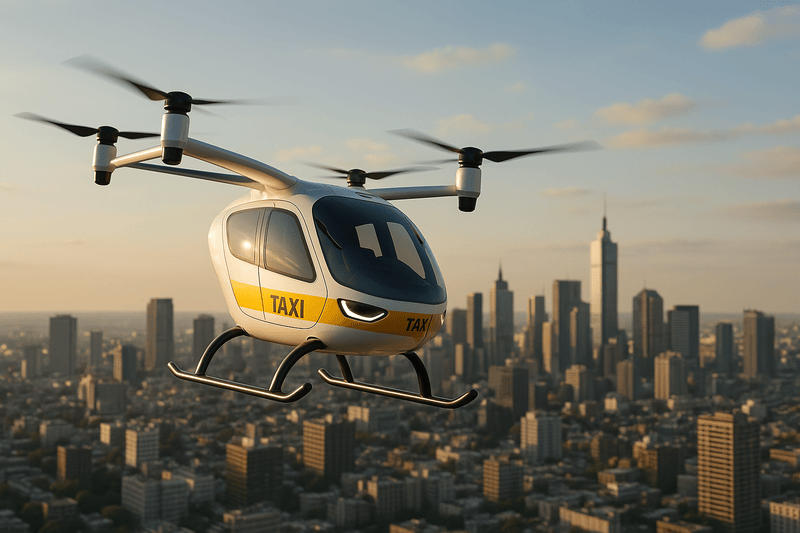
Ever stared up at a clear blue sky and thought, “Someday I’m flying in one of those jetpack things like in The Fifth Element?” Well, buckle your seatbelt—flying taxis are no longer sci-fi daydreams. In 2025, companies around the globe are taxiing prototypes to takeoff pads, logging flight hours, and hinting at a future where the morning commute might just involve a vertical lift. Curious about what’s really happening with these airborne cabs? Let’s hop aboard, starting with the U.S., then zip over to Europe, and finally land in Dubai—because if you thought Dubai’s roads were fast, wait until you try their skies.
United States: From Silicon Valley Dreams to FAA Reality Checks
Picture this: it’s rush hour in Los Angeles. Freeway backup for miles. You glance at your phone, tap a few buttons, and ten minutes later you’re ascending above gridlock in a silent electric aircraft, feeling like the main character of a superhero origin story. That’s the vision companies like Joby Aviation and Archer Aviation are chasing. In early 2025, Joby’s five-seat electric VTOL (Vertical Takeoff and Landing) passed key FAA safety tests. Engineers have been fine-tuning its tilt-rotor design so quietly that even the local crows seem puzzled, asking each other, “Is that a bird or another takeout drone?” Meanwhile, Archer’s Midnight eVTOL has been logging demo flights in Texas. They’ve even opened a pilot training program near Austin—pilots are learning to handle everything from sudden gusts to curious eagles that occasionally swoop in for a closer look.
Of course, any new mode of transportation needs a healthy dose of regulatory scrutiny. The FAA’s cautious nod means more rigorous inspections, pilot certifications, and noise tests. Remember when drones had you worried about nosy neighbors? Multiply that by a few tons of metal carrying passengers. Yet, by March 2025, Archer managed a collision-avoidance trial in Dallas, weaving the Midnight between mock towers and balloons simulating other aircraft. The result? A thumbs-up from regulators that said, “Okay—no near misses, just near-futures.”
Example moment: Charlotte, a software engineer in San Francisco, watched from the rooftop of her coworking space as a Joby prototype lifted off. She quipped, “I half expected it to beep like my ride-share drone. Instead, it rose smoothly, like someone tucked a normal car into a flying umbrella.” Her neighbor, always skeptical of “fancy tech,” admitted, “Honestly, I’d give it a try if it means skipping the Bay Bridge traffic.”
Europe: Old-World Charm Meets High-Tech Hums
Hop across the pond, and you’ll find cities like Paris and Munich testing their skies. European startups and established aerospace giants are partnering to launch eVTOL trials that blend efficiency with a dash of European flair. In Munich, Lilium’s electric jet—shaped more like a futuristic bullet than a helicopter—completed public demonstration flights around the airport, wowing onlookers with speeds up to 175 mph. Architects have even started sketching rooftop vertiports onto new high-rise plans. Imagine sipping a latte in a Fifth Avenue-style café, then boarding a sleek black-and-gold jet to zip to Berlin in under an hour. No more dreary train rides that feel like a relic from the 19th century.
Paris, never content with being anything less than dramatic, hosted Volocopter’s VoloCity for a high-profile trial during Fashion Week. The idea: fashion influencers could hop in from a floating pad near the Seine, camera drones capturing every descent as though it were a runway finale. Volocopter built a temporary vertiport on the roof of a Haussmann-era building—complete with Eiffel Tower views—and people lined up to taste “the Parisian commute.” Yes, it costs more than a baguette, but that’s part of the fun. “I felt like James Bond, but with better hair,” one influencer joked on Instagram, captioning a selfie with Volocopter’s pilot wearing an aviator helmet.
Dubai: Where Tomorrow Arrives Today
If there’s a city designed for flying cars, it’s Dubai. Known for building islands shaped like palm trees and hotels that pierce the heavens, Dubai’s aviation ambitions are a natural extension of neon-lit dreams. The Roads and Transport Authority (RTA) partnered with Volocopter to launch trials under the name “Dubai Air Taxi.” The first flights launched in late 2024, ferrying passengers between the Burj Khalifa district and Al Maktoum International Airport. By May 2025, daily demonstration flights were greeting tourists willing to splurge for a bird’s-eye view of the city’s dancing fountains and sand dunes beyond.
But the real headline-grabber was the introduction of EHang’s autonomous passenger drone on limited routes. These 2-seater “flying pods” lifted off from Palm Jumeirah’s helipad and glided smoothly toward Dubai Marina—no pilot needed. Passengers simply tapped their destination into a touchscreen, sat back, and enjoyed the gentle hum of eight electric rotors. Inside, mood lighting adjusted to the sunset, offering a mini light show as the city skyline twinkled below. “It felt like Hogwarts Express, but airborne and without the platform barriers,” said Leila, a tourist from London, smiling as she disembarked atop a skyscraper.
Of course, Dubai isn’t blind to safety concerns. Heat can be a factor—aircraft electronics and rotors have to perform flawlessly despite temperatures peaking above 110°F. Engineers installed cooling bays at the vertiports, where eVTOLs “rest” in shaded, air-conditioned hangars between flights. Even so, pilots and techs joke that desert testing makes their prototypes tougher than any Hollywood stunt double. If a flying taxi can survive a sandstorm and 120-degree days, it’s ready for anything.
Common Hurdles: Charging, Infrastructure, and That Pesky Price Tag
Before you clear your morning schedule and start window-shopping for personal flying pods, let’s talk hurdles. First up: charging. Most eVTOL companies tout quick-swap battery systems, but these still require dedicated ground crews and standardized docking stations. Cities need to retrofit rooftops, parking garages, or build entirely new “vertiports” that look less like conventional helipads and more like mini futuristic airports. It’s one thing to land a prototype in a remote test field; another to carve out precious real estate on Fifth Avenue or Champs-Élysée.
There’s also the question of noise—or lack thereof. While electric motors hum much quieter than traditional helicopters, they’re still “hummy.” Residents beneath flight paths are raising eyebrows. Will anyone want to live under a route where, every few minutes, a faint buzzing reminds them, “Yes, your neighbor is on their way to work by air”? Companies are experimenting with rotor designs and software-driven pitch adjustments to minimize noise, but achieving near-silence remains an engineering holy grail.
Finally, the price tag. A single eVTOL flight from downtown Manhattan to JFK costs more than a limousine ride—think high three digits at least. Not exactly budget-friendly. But as production scales up, costs are expected to drop. Early adopters—couriers, medical transport, even some corporate execs—are already signing contracts. And as airlines eye short-haul routes, we might see a future where flying taxis complement regional flights, connecting smaller cities without requiring massive airports.
The Passenger Experience: From Virtual Check-In to Above-the-City Selfies
Let’s remember the fun part: actually being a passenger. Picture yourself booking a flight through a slick app—no phone tree loops, no “press 1 for flights”—just tap your destination, choose your pickup pad (maybe a converted rooftop pool deck?), and get a boarding pass QR code. A friendly ground staffer scans your code, you step into a sleek cabin lined with soft leather seats and panoramic windows, and you’re off—no turbulence, no screaming kids, and no backseat drivers judging your driving playlist.
En route, the aircraft’s smart displays show your trajectory, estimated time of arrival, and even point out landmarks below—“On your right, that’s Central Park, looking greener than ever.” If you’re feeling extra touristy, you can snap selfies from altitudes that normally only eagles enjoy. And did we mention zero traffic jams? Under a sky glowing with sunrise hues, you’ll realize why people are betting big on air taxis: it’s not just about saving time, it’s about turning commutes into experiences.
Final Descent: Should You Strap In?
So are flying taxis going to replace every Uber ride tomorrow? Not quite. We still need more time for regulations, infrastructure, and cost reductions. But in 2025, we’re witnessing historic first steps: FAA approvals in the U.S., sleek European demos over iconic skylines, and Dubai’s audacious Dreamscape taking passengers above the desert. It’s a global race to see who can tame the skies first—and let’s be honest, watching prototypes zip between skyscrapers feels like living in a video game.
If you’re chomping at the bit to ride, keep an eye on local trials. Sign up for waiting lists if you can—pilots spots might vanish faster than concert tickets. And when you finally do take that airborne taxi, remember to send a postcard to your gridlocked friends below: “Wish you were here—but not stuck in traffic.”
Because one thing’s for sure: by the end of 2025, your commute might just include the phrase “I’ll see you from above.” Ready for takeoff?