



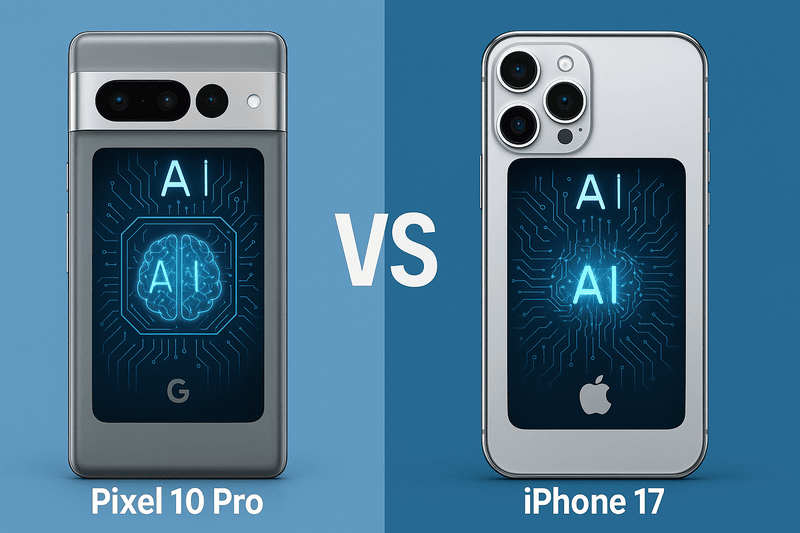
The smartphone war has officially entered its AI era. Gone are the days when flagship debates revolved solely around megapixel counts and optical zoom. In 2025, Google’s Pixel 10 Pro and Apple’s iPhone 17 are duking it out with onboard AI smarts that promise to transform how we shoot, edit, and even interact with our devices. But are we really paying for AI horsepower now more than camera hardware? Let’s unpack what makes these two beasts tick—and why you might care more about neural nets than lenses.
Pixel 10 Pro: Google’s AI-First Photography Powerhouse
A Sneak Peek at Pixel 10 Pro’s Design and AI Ambitions
Leaks earlier this month gave us a first look at the Pixel 10 Pro’s design—minimal changes from the Pixel 9, but a clear nod toward AI-driven features. A leaked ad shoot filmed on a Vancouver beach revealed a tagline promising “ask more of your phone,” hinting that Google hasn’t abandoned its AI-first strategy (The Economic Times, TechRadar). Under the hood, we expect the next-generation Tensor chip—likely Tensor G4—to fuel AI tasks such as real-time scene understanding, generative image edits, and advanced computational photography.
From “Add Me” to “Reimagine”: AI That Does the Heavy Lifting
If you owned a Pixel 8 Pro or Pixel 9 Pro, you’ve already sampled features like Magic Editor, Add Me, and Super Res Zoom. On the Pixel 10 Pro, those tools are being taken to eleven. Imagine pointing your camera at a group on a windy beach, then tapping “Add Me” to reinsert yourself into the shot—Google first introduced this on Pixel 8 Pro, powered by Tensor G3, and it’s only getting more seamless (The Times of India, HT Tech).
But the real headliner is the revamped “Reimagine” tool. Instead of simply removing background clutter, the Pixel 10 Pro’s AI can generate new scene elements based on context. Picture this: you snap a photo of your mountain hike, then describe “make it look like a sunset festival,” and the phone’s generative model conjures colorful lanterns and festival tents, all rendered convincingly in real time. This level of on-device generative AI was previously exclusive to cloud-based solutions; now it’s happening in your pocket.
Camera Specs: Still Solid, But No Longer the Star
Under its hood, the Pixel 10 Pro retains a triple-lens setup: a 50 MP main sensor, a 48 MP ultra-wide, and a 12 MP 5x telephoto. On paper, those numbers are an incremental bump from Pixel 9 Pro, but Google is relying less on raw hardware and more on neural processing. Battery life receives a boost via AI-powered power management that predicts your usage patterns—if you binge-watch YouTube at 2 AM, the phone nudges background processes to sleep until you wake up (TechRadar, The Verge).
Pros:
- AI-based scene optimization for every shot
- On-device generative editing (Reimagine)
- Smarter battery management via machine learning
Cons:
- Modest sensor upgrades compared to previous generation
- Premium price tag reflecting AI-focused R&D
iPhone 17: Apple’s AI Evolution Meets iOS 19
“Apple Intelligence” Finally Matters on Hardware
Apple’s AI story has been more software-centric until now—Siri improvements and systemwide writing tools debuted in iOS 18, but many features required cloud processing due to hardware limits (Apple, Apple). With the iPhone 17, rumors suggest up to 12 GB of RAM—double what most iPhones had just a year ago—specifically to handle on-device large language models (LLMs) for “Apple Intelligence” features (Tom’s Guide, Cinco Días). This is Apple’s answer to Google’s Gemini/dedicated AI stack: powerful local AI that doesn’t rely on external servers for basic tasks.
Camera Hardware Still Matters, But AI Steals the Spotlight
The iPhone 17 reportedly keeps its triple-lens arrangement—48 MP main, 12 MP ultra-wide, and a 10 MP 3x telephoto—largely unchanged from the iPhone 16 Pro. Instead of chasing megapixels, Apple focuses on “Computational Photography 3.0,” where AI guides low-light optimization, dynamic range blending, and even stylistic filters that adapt to your shooting style. In practice, when you shoot a night-time concert, the phone’s neural engine analyzes the scene, isolates performers, and enhances stage lighting in real time—all without you lifting a finger (Cinco Días, Apple).
Where iPhone 17 outpaces many competitors is seamless software integration. Thanks to iOS 19’s systemwide “Image Playground,” you can tap anywhere in the Photos app, type “make this a moody film poster,” and watch your stills transform instantly. It’s like having a mini-Photoshop built into your gallery—no cloud needed. Want to remove that random stranger in the background? The “Clean Up” tool (powered by Apple Intelligence) analyzes depth data and seamlessly reconstructs the background layer (Apple, Wikipedia).
Personal AI: More Than Just a Fancy Siri
On the Pixel side, “Gemini Live” can answer questions mid-conversation, but it still offloads heavy lifting to the cloud. Apple’s AI push on iPhone 17 includes a more capable Siri that leverages on-device LLMs for context-aware responses—meaning you can ask “Siri, finish drafting that email in the style of Hemingway,” and get a near-immediate answer without your data leaving the phone. You can also let Siri tap into ChatGPT for deeper queries—if you opt in—while maintaining privacy prompts each time for transparency (The Times of India, Apple).
Pros:
- On-device LLMs for faster, privacy-focused AI
- Computational Photography driven by neural engines
- Seamless integration with Apple’s ecosystem (Image Playground, Genmoji, Clean Up)
Cons:
- Camera hardware changes are incremental
- Early “Apple Intelligence” features may be buggy until iOS 19 matures
Shifting the Narrative: Are We Really Paying for AI Over Optics?
Just a few years ago, flagship battles were won by chasing bigger sensors, more rear cameras, or higher optical zoom. In 2025, Pixel 10 Pro and iPhone 17 demonstrate a different approach: hardware is important, but AI is the crown jewel. You’re paying for faster neural chips, extra RAM, and advanced on-device ML pipelines—features that, frankly, were reserved for cloud servers just a year ago.
Consider this real-world example: Saurabh, a travel blogger in Delhi, recently compared his old Pixel 9 Pro with a friend’s iPhone 15 Pro on a mountain trek. The Pixel 9’s Super Res Zoom and Magic Editor were impressive, but once he upgraded to Pixel 10 Pro, he spent less time fiddling with manual adjustments. He simply described “make this waterfall look ethereal at twilight,” and watched his shot morph into a magazine cover—no desktop needed. Meanwhile, his friend on iPhone 15 Pro still wrestled with manual low-light modes and third-party apps for advanced edits. AI won that day.
On the Apple side, Priya, a freelance designer in Bengaluru, raves about iPhone 17’s Image Playground. In one example, she turned a casual café photo into a graphic-novel–style splash image by typing “transform into noir comic.” The entire expansion and line-work happened in seconds. Her colleague on a Pixel 9 had to export to desktop tools to achieve a similar effect.
Which Should You Choose? AI Ecosystem or Pure Photographic Muscle?
- Pick Pixel 10 Pro if you love Google’s AI ecosystem—Gemini integration, headline-earning generative edits, and if you already trust Google Photos’s AI-powered editor (The Verge, HT Tech). You’ll want the flexibility of Tensor-powered auto-scene tweaking and “Reimagine” prompts.
- Pick iPhone 17 if you live in Apple’s universe—Seamless handoff to Mac, built-in Image Playground, and on-device compatibility with ChatGPT and Apple Intelligence, all wrapped in iOS 19’s privacy-focused framework (Cinco Días, Apple). You’ll appreciate instant generative edits without having to tap into the cloud.
If pure lens prowess still matters, you might be disappointed: both phones lean into AI to compensate for modest sensor upgrades. But if you crave photography that adapts to your vision (rather than you adapting to technical menus), AI-centric flagships are your jam.
Verdict: Camera Gear Upgrades Are So 2020
By 2025, the question is less “Who has a bigger sensor?” and more “Who has the smartest neural engines?” Pixel 10 Pro and iPhone 17 both demonstrate that AI—be it for generative editing, contextual scene optimization, or on-device LLMs—is the new battleground. Will your bank account hemorrhage more for these AI chips than for shiny new optics? Probably. Will it be worth it when your phone anticipates you need that cinematic “golden hour” boost or whip up a month’s worth of social-media posts in minutes? That depends on how much you value time saved and creative firepower at your fingertips.
So yes, in 2025, we’re paying more for AI than pixels—and we’re loving it. Use these insights to decide which ecosystem—Google’s Gemini-driven machine or Apple’s “Apple Intelligence” fortress—best suits your workflow. Whichever side you choose, one thing is clear: the future of smartphone photography is less about glass and more about brains.