
Ever wondered what it’d feel like to watch a TV show scripted, shot, and edited by an algorithm that never sleeps? Picture this: you’re lounging in your favorite chair, popcorn in hand, and the protagonist bursts onto the screen—except that protagonist doesn’t even exist in the real world. Their voice was generated by AI, their face stitched together from thousands of images, and the plot was brainstormed by a neural network during your lunch break. If this sounds like sci-fi, welcome to 2025, where AI-generated series are no longer a wild experiment but a full-fledged genre taking over your binge list.
A Glimpse Behind the Curtain: From Algorithms to Actors
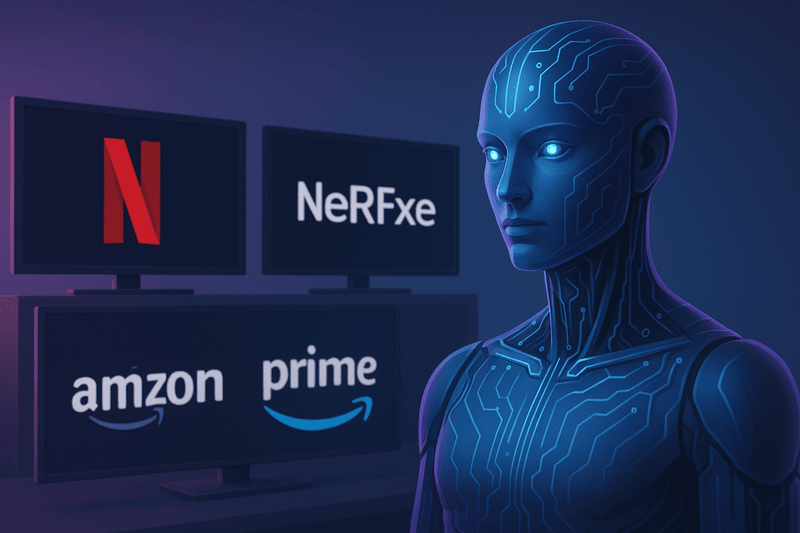
Remember when Netflix dropped “Love, Death + Robots” and left us gasping at its animation wizardry? If that was a taste of creative ambition, consider AI-generated shows the full buffet. Instead of human writers, these series start with models like GPT-5 or its successors, chewing on vast archives of scripts, novels, and fan theories to spit out dialogue, character arcs, and twists so meta you’ll be double-checking your own reflection. But it doesn’t stop there. Enter NeRFx—the latest kid on the AI block—which uses Neural Radiance Fields (NeRF) to build immersive 3D scenes from simple sketches. The outcome? Environments that look so real, you’ll swear you can smell the rain on those digital city streets.
Imagine a detective series where each scene is generated on the fly: one moment you’re in a neon-lit alleyway in Tokyo, and by the next cliffhanger, your copter pans over a fog-drenched London skyline. All of it rendered by NeRFx in real time. The result is cinema-level production without the cluster of cameras, lighting rigs, and location permits. Cool, right? Or a little unsettling?
Netflix Leads the Charge (With a Dash of Chaos)
Netflix has never shied away from a gamble. In early 2024, they quietly released “Algorithm & Co.,” a short-form anthology where each episode’s script was 80 percent AI-generated. The first episode kicked off with an eerie message: “Warning—this story may be too unpredictable even for its creators.” Viewers witnessed a time-traveling pastry chef who accidentally altered the internet’s origin story. Critics were split—some lauded its refreshing unpredictability, while others complained the pacing felt like a caffeinated hamster on a wheel.
But Netflix didn’t throw in the towel. Instead, they doubled down, collaborating with NeRFx to produce “Synthetic Scenarios,” a six-episode miniseries where not a single human finger touched a camera. Actors were digital—faces crafted from countless data points, voices sculpted by text-to-speech systems fine-tuned on award-winning thespians. The show’s pilot, “Pixelated Hearts,” portrayed an AI that learns about human emotions by binge-watching soap operas. It was like watching a robot nurse its first heartbreak. Somewhere between “aww” and “wait, what?” fans realized AI can do more than crunch numbers—it can make us feel.
Amazon Prime’s Experimental Playground
Not to be outdone, Amazon Prime jumped into the ring with “PrimePattern,” a platform-agnostic showcase of AI-driven pilots. They threw interesting ideas at the wall—supernatural comedies, futuristic documentaries, and even a cooking show where the AI chef never repeats a recipe. One standout was “Neon Knights,” a cyberpunk tale where every viewer got a slightly different version based on their watch history. If you’re into action, you’d see extra fight scenes; if you prefer romance, more scenes of star-crossed lovers under holographic cherry blossoms. It felt a bit like choosing-your-own-adventure but with Hollywood budgets.
Behind the scenes, Amazon’s engineers fed terabytes of sci-fi novels, manga, and indie film scripts into custom AI pipelines. The models spat out storyboards, character designs, and scene beats. Human editors stepped in just to add that final polish—trimming awkward dialogue, adjusting pacing, and, crucially, making sure the AI didn’t accidentally give someone seven arms. Talk about a plot twist nobody saw coming.
Why This Matters (Beyond the Wow Factor)
You might be thinking, “Great, more gimmicks. But do I really care if a bot wrote my next favorite show?” The answer is a resounding maybe. AI-generated content isn’t just a flashy headline; it’s reshaping how entertainment is made. Budgets that once needed tens of millions for CGI can now be slashed by up to 40 percent. Studios can prototype ten pilots in the time it used to take to finish one—some succeed wildly, others flop spectacularly, but the odds favor experimentation. For indie creators, AI means leveling the playing field: a single storyteller with a laptop can conjure worlds that would’ve required entire crews a decade ago.
Plus, diversity in storytelling gets a turbo boost. By training models on global literature, you get narratives that blend genres and cultures in unexpected ways. Imagine a samurai western set on Mars or a medieval rom-com starring a shape-shifting AI. Traditional gatekeepers—studio heads and focus groups—can be bypassed. Viewers hungry for fresh voices can feast on flavors they didn’t even know existed.
The Human Touch: Still Uniquely Necessary
Before you start worrying about a robot apocalypse in Hollywood, take a deep breath. Human creativity isn’t being replaced—it’s being amplified. AI might generate a compelling storyline about a detective clone falling in love with a hologram, but it takes a human to decide what that relationship means on a deeper level. Showrunners, directors, and actors still pour heart and nuance into characters. The AI lays down the blueprint, but humans add the soul.
Consider one of Amazon’s early experiments: “Pixel Pilgrim,” a drama about virtual reality missionaries. The AI wrote a scene where the protagonist preaches to a congregation of avatars shaped like rubber ducks. Hilarious on paper, but director Monisha Patel chose to replace the ducks with floating lanterns instead—a symbolic choice about hope. That small decision transformed a quirky bit into a poignant moment viewers still talk about.
What’s Next? Buckle Up
If 2025 is any indication, AI-generated series are still in their infancy. NeRFx, GPT-7, and their successors will only get sharper, more intuitive, and eerily human. By 2026, expect fully interactive series where your choices not only branch the storyline but retrain the AI, creating a living narrative that evolves with audience feedback. Think of it like a communal campfire where hundreds of storytellers chip in mid-episode.
And if you’re already wondering how to break into this new frontier, start experimenting. Learn the basics of prompt engineering, play around with open-source NeRF tools, or sign up for early-access programs on Netflix’s Creator Lab. You might just stumble upon the next viral hit—one where viewers can’t tell if the tears in their eyes are from your script or the AI’s uncanny knack for timing a punchline.
Curtain Call: Embracing the Unpredictable
So, from Netflix’s half-human comedies to NeRFx’s jaw-dropping environments, the age of AI-generated shows is here to stay. It’s a wild ride—part sci-fi, part creative revolution. If you’re a viewer, prepare for stories that shift and shimmer in ways you never expected. If you’re a creator, gear up to collaborate with algorithms that push your imagination further than ever before.
In the end, whether it’s a digital detective falling in love with a virtual ghost or a cooking contest judged by a robot, the magic lies in the synchronicity of humans and AI. One writes the code, the other writes the heart. And together, they’re rewriting the way we watch, feel, and dream. Excited? You should be. Popcorn at the ready—your next binge might just be scripted by a machine, directed by a human, and powered by pure, unadulterated creativity.