

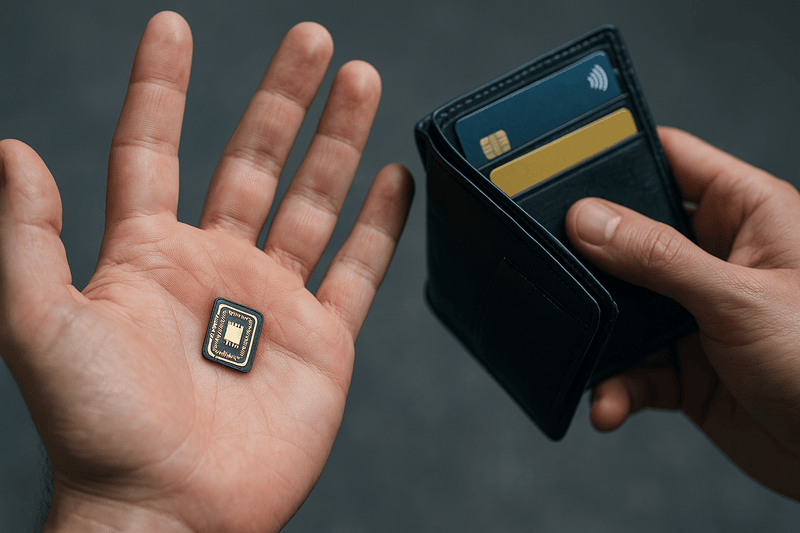
Ever felt your wallet bulge so much it threatened to go on strike? What if you could leave that brick of cards and cash at home—maybe even forget it entirely—because your hand already holds everything you need? Welcome to 2025, where implantable biochips are leaping off sci-fi pages and right under your skin. From tapping for groceries to streaming your latest ECG report, these tiny wonders promise to replace more than just your wallet. Curious? Buckle up (or don’t—your pockets will thank you), as we dig into the rise of biochips for payments, health, and ID—no big leather accessory required.
Biochips 101: Tiny Tech with Massive Potential
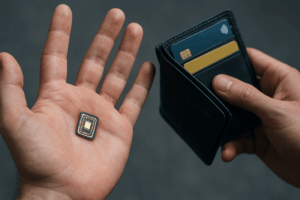
Let’s start with the basics. Biochips—sometimes called microchips, implantables, or RFID/NFC nestling under your skin—are about the size of a grain of rice. They house circuits and antennas that communicate with external readers. Initially, they showed up in sci-fi flicks as villain-tracking devices; today, they’re legitimate market gold. In 2024, the human microchipping industry was valued at around USD 1.85 billion and is expected to hit nearly USD 1.99 billion by the end of 2025—a steady 7.8% CAGR that hints at major growth to follow (openPR.com). In other words, these chips are going from niche hobbyist experiments to mainstream gadgets faster than you can say “Wait, can you really pay with that?”
Bye-Bye Wallet—Hello Hand-Tap Payments
Remember fumbling for a credit card when your other hand is busy balancing three grocery bags? With a biochip, you simply wave your hand over an NFC-enabled terminal, and voila—transaction complete. Major fintech players and startups alike are diving into this trend. According to industry data, uses for microchip implants include payment cards and cryptocurrency wallets—yes, you could literally store Bitcoin under your skin and spend it in the cereal aisle if you wanted (Wikipedia).
Example moment: Meet Alex, a software developer in Berlin who got a NFC implant last year. One morning, he strolls into his local bakery, taps his palm on the terminal—and the cost of a buttery croissant zings straight to his bank account. No phone, no plastic, no drama. His friends joke that he’s now part cyborg but insist that losing his wallet is still his biggest fear—until it wasn’t.
Biochips in Medicine: Health on the Go
But biochips aren’t just for spending—they’re life-saving. Imagine a diabetic who never misses a glucose check because a tiny implant continuously streams data to their phone. Or an allergy sufferer whose emergency medical ID springs up on any compatible reader—paramedics instantly know they’re Team Peanut-Free. In 2025, the “microchips in medicine” segment is already a USD 1.27 billion industry, forecast to accelerate as hospitals seek real-time diagnostics and seamless patient monitoring (Research Nester).
These implants can store vital medical records—blood type, vaccination status, chronic conditions—so if you’re in a crash and unconscious, a quick scan reveals everything first responders need. No more frantic phone calls or missing paperwork. For patients in remote areas, biochips can trigger alerts to doctors if a pacemaker needs attention or if drug delivery routines—like insulin pumps—require tweaking. It’s like having a 24/7 personal health assistant permanently embedded in your arm.
ID and Security: Your Hand as the New Keycard
Ever lost your office badge on a Friday night? Biochips could make that obsolete. Companies are exploring implants that replace keycards, allowing employees to access secure areas with a mere wave of the hand (openPR.com). No more frantic searches through pockets or dumping an entire bag on the floor at the security desk. Some nightclubs in Sweden even let members tap to enter—no queue, no fuss—just a discreet subdermal chip doing all the work.
On the home front, savvy early adopters are using biochips to unlock smart locks. Forget fumbling for your phone’s digital key; one swift gesture at your doorstep and your smart lock purrs open. Of course, this raises questions about what happens if you lose that chip—or more accurately, lose your hand. (Pro tip: Don’t get into a sword fight anytime soon.)
Real-World Biohackers: From Bitcoin to Bouncer Access
Let’s zoom in on some of the actual humans who’ve gone under the knife—well, mostly a syringe—so they could live like Bond meets The Jetsons. One famous example is an Australian guy who shelled out about USD 75 to stash crypto in his hand. (Note: Don’t try this at home unless you really enjoy explaining to your grandmother why you can’t sign her birthday card—because your thumbprint is now a crypto key.) Then there’s the tale of those gym regulars in Stockholm who got chips to skip the front desk—tap their hands, and the turnstile swings open. Like membership perks for modern knights.
These biohackers aren’t just chasing novelty. They’re testing the limits of convenience and personal freedom—albeit flirting with privacy, security, and ethical hot potatoes. Yet, their adventures give us a glimpse of what mainstream life might look like if implantable tech goes mass-market.
Pros, Cons, and the “Why-Should-I-Care?” Factor
Pros:
- Convenience Overload: One tap replaces bulky wallets, medical cards, and key fobs.
- Enhanced Health Monitoring: Real-time data, fewer hospital visits, faster responses in emergencies.
- Streamlined Access: From offices to gyms, your hand becomes the ultimate all-access pass.
Cons:
- Privacy Pandemonium: Who controls your data? If someone hacks the reader, can they steal your identity?
- Security Snags: Unlike credit cards, you can’t simply “cancel” your hand. Implants raise novel cybersecurity risks.
- Ethical Quandaries: Is it right to be nudged by medical device alerts 24/7? What about consent in corporate settings—can employers require them for building access?
With great power comes great responsibility—and a healthy side of caution is warranted. Implant advocates argue that encryption and secure channels mitigate many risks, yet skeptics insist there’s no digital fortress so strong a determined hacker can’t crack it.
Looking Ahead: Will Biochips Become as Common as Smartwatches?
So, what’s next? By 2030, experts forecast the global biochips market could surge beyond USD 3 billion, fueled by semiconductors shrinking further and integration with AI for predictive health analytics (Coherent Market Insights, ScienceDirect). Imagine a future where your refrigerator scans your chip, knows your dietary restrictions, and suggests recipes. Or your car refuses to start unless it detects your biochip and confirms you—and only you—are driving. Heck, maybe you’ll use it to “like” an Instagram post with nothing more than a thought linked through a brain-computer interface. The sky’s the limit—assuming you can look up without bumping your head on the nozzle of a self-driving drone.
Still, mainstream adoption hinges on cost, safety, and, let’s face it, social comfort. Many will balk at voluntarily inserting tech under their skin. Religious, cultural, or personal beliefs could spark heated debates. Regulators are scrambling to draft guidelines: What qualifies as “acceptable medical risk”? Who’s liable if a chip malfunctions—doctor, manufacturer, or you for clicking “Yes, implant me” on the consent form?
Final Thoughts: Swipe Right on Biochips (Eventually)
At their core, biochips blur the line between human and hardware. They’re neither cure-all nor dystopian nightmare—they’re tools, and like any tool, their value depends on how we use them. If you love the idea of never misplacing your card and having your health data at your fingertips, biochips might just be the future accessory you never knew you needed. If, however, you relish the feeling of an analog wallet in your pocket and enjoy human error at checkout (hey, we’ve all been there), maybe you’ll opt to keep living the old-fashioned way.
One thing’s for sure: in 2025, biochips are no longer a fringe curiosity. They’re knocking on the mainstream’s door—asking, “Can I come in?” Whether you say yes or not, they’re changing the way we think about convenience, privacy, and identity. So the next time someone casually mentions they paid for coffee with a tap of the hand, you’ll know: we’ve officially entered the era where our wallets might live inside us, not in our jeans.
Ready to ditch that coin purse? Just make sure to keep an eye on regulations and, above all, your implanted PIN. Because losing a chip isn’t like misplacing a wallet—but it might be a lot more interesting to explain.